Overview
The Today page is your daily work queue — who to contact, what's overdue, and new leads the moment they arrive.
Today is where SmileLine lands you after every sign-in, and where your front desk spends the day. By the end of this page you'll know how to read the queue, jump between its sections, preview the days ahead, and spot new leads the moment they arrive.
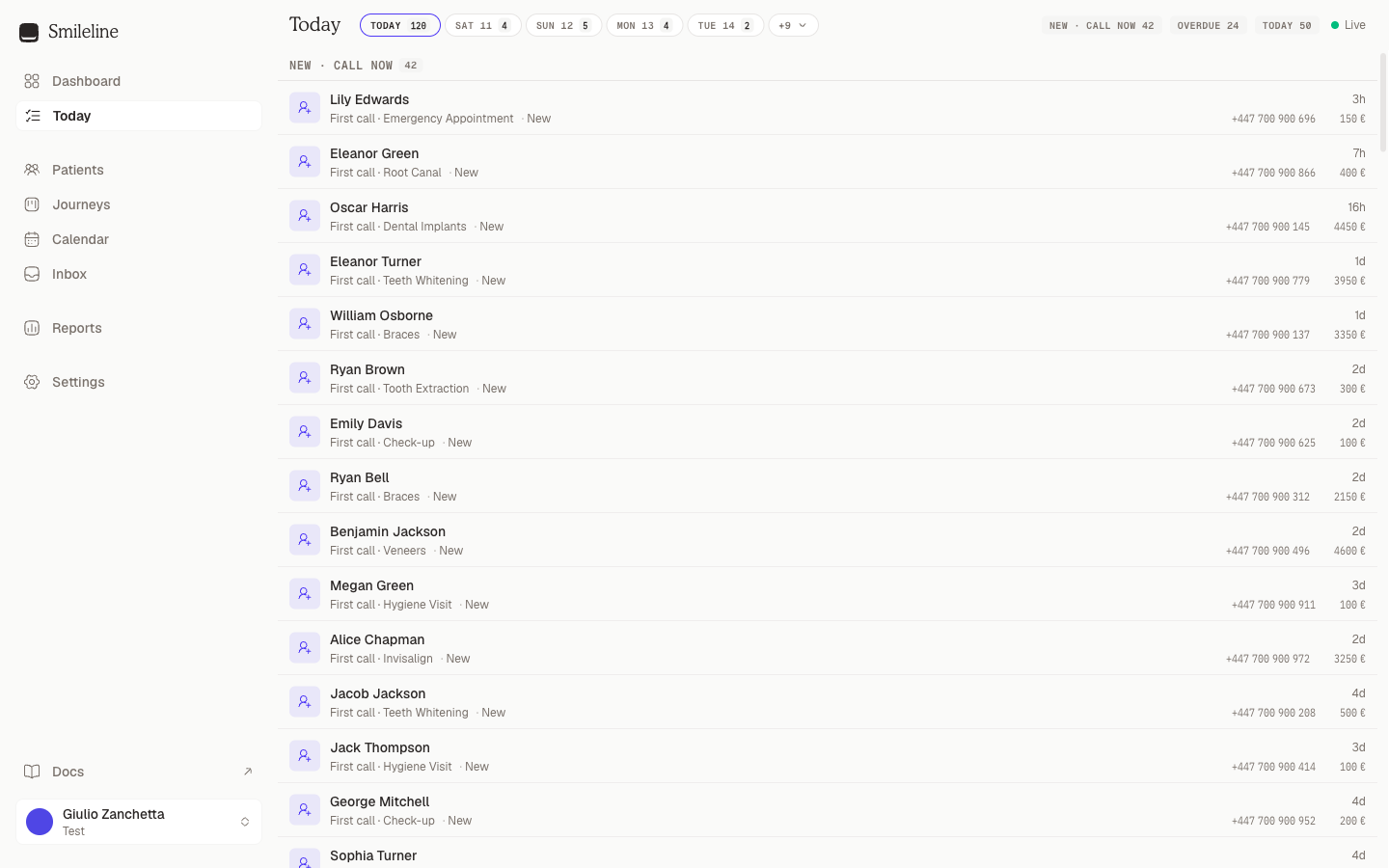
What's in the queue
The queue is sorted for you, top to bottom, into four buckets:
- New · Call now — brand-new leads nobody has contacted yet. People who phoned come first — an Incoming call card with a phone icon, whether the call came through Smileline Voice, a tracking number or a phone system connected as a custom integration — then the newest form leads. Speed matters most here: call these before anything else. A lead who left no mobile number reads First contact rather than First call, and its work panel asks how you reached them instead. Someone already waiting here who enquires again moves back to the top as one fresh card, and the bell rings again; there is never a second card for the same person.
- Overdue — tasks past their due date, oldest first.
- Today — tasks due today, plus new enquiries that need triaging.
- Upcoming — tomorrow's follow-ups and undated tasks, collapsed by default. Click the header to expand it.
When there's nothing left, the queue says All clear — new leads land here the moment they arrive.
Reading a row
Each row is two lines with an icon square on the left:
- The icon tells you the type at a glance: new lead, enquiry, follow-up (call, text, email or WhatsApp) or a plain task. Overdue items are tinted red.
- Line one shows the patient's name and, on the right, how old the lead is or when the task is due.
- Line two shows what to do, the journey stage, the assignee, the treatment value, and the patient's phone number — click the number to copy it without opening the row.
The work panel on the right is always open and automatically shows the first item that needs attention — click a row (or press Enter) to switch to a different one. It reads top to bottom in the order a call needs: the patient's summary first — the name and treatment, a medical-alert flag when there is one, and the due time — then the task itself in a card, which is where you record what happened. That card's tint says what kind of work it is: blue for a new lead, amber for a follow-up, green for a booking to confirm and violet for an enquiry to triage. Under it sit three cards that open when you want them and stay shut when you don't: Recent activity, with a quick note box — hover an entry's age to see the exact date and time — Edit patient details, which holds the journey progress, the patient's details and where the lead came from, and Pitch. Each one summarises itself while it is closed: the last three things that happened, and the lead's value, owner and age. Only filled-in details are shown; the full record is one click away via Open full patient record. Those details edit in place, the same way they do on the patient record — click the date of birth, gender, address, language, preferred channel, fiscal code, other phone or medical alert to correct it mid-call. In the source block, the lead source is editable; the rest of that block is the arrival record (channel, campaign, capture form, when it was captured) and is never rewritten. Adding a detail the patient does not have yet still happens on the full record. Opening an enquiry shows a triage card instead. It leads with Enquiry: what they actually submitted, their message first and then every other answer the form asked for, so you can read the request before you act on it. (Attribution parameters and the name, email and phone your form mapping already put on the record are left out; the complete body stays in the form's delivery history under Settings → Website.) Under it, confirm the treatment they're interested in to create a journey: they re-enter the queue as a New · Call now card and the panel stays on them, so you can call or book them in straight away. Or dismiss the enquiry to archive the patient. An enquiry that arrived without a form submission, such as one typed in by hand, shows the card on its own.
Chatting with the patient
The work panel has two tabs: Overview, where you record what happened, and Chat, which holds the patient's conversation — the same WhatsApp, SMS and email thread you'd see in the Inbox. On Chat you reply, switch channels, leave internal notes and use templates exactly as you would in the Inbox, without leaving the queue.
A badge on the Chat tab counts the conversation's unread messages (99+ past ninety-nine); opening the tab marks it as read for the whole team, just like opening it in the Inbox. Queue rows carry the same fact more quietly: a dot beside a lead's name means that patient has messages waiting, so you can see who is owed a reply without opening each row. If nobody has messaged the patient yet, the tab shows an empty thread with the composer ready underneath it, set to Email — switch the channel from the composer's picker if you'd rather text or WhatsApp them. Templates and attachments work as they do in the Inbox; the first message you send starts the thread right there in the panel. WhatsApp outside a 24-hour window carries approved templates only, exactly as in the Inbox.
The Chat tab appears for roles with Inbox access, and its composer for roles that can send messages. A channel appears in the picker only when it is connected and the patient has a number or address for it.
The sales pitch
Pitch, the last card on Overview, is what to say on this call. Open it and it shows your practice pitch first — the part that's true whatever the treatment — then the pitch written for the treatment on this lead's journey, under its name. It's read-only: nothing in the card changes the patient's record, so you can open it mid-call without losing your place in the outcome card above it.
Change the treatment on the lead and the card follows it. If neither pitch has been written yet, the card says so and offers Write one, which takes you to Settings → Treatments — see Vocabularies for how to write them.
Everyone who can work the queue can read the pitch. Writing one needs settings access.
Counters
The header shows a compact icon and clickable counter for each non-empty bucket — a new-lead icon for New · Call now, a clock for Overdue and a calendar for Today. Hover or focus an icon to see its bucket name, or click it to jump straight to that section of the queue. When something new lands in a bucket, its counter pulses briefly.
Filtering the queue
Click the filter icon in the header to focus the queue on just what you're after. A dropdown opens with a search box and every option carries a count of the queue items it covers:
- Task types — new leads, follow-ups, bookings to confirm, enquiries or plain tasks.
- Treatments, Stages and Assignees — built from what's actually in today's queue, so picking Assignees → you is the quickest way to see only your own leads.
- Clients — type a name in the search box and pick the client to see just their items.
Pick as many options as you like: choices within a group widen the match, groups combine to narrow it — New lead plus Invisalign shows only new Invisalign leads.
Everything you have picked appears as a row of chips just under the dropdown's search box, so you can see what's on at a glance. Click a chip's ✕ to drop that one choice without hunting for it back down in its group.
While a filter is on, the icon shows a badge with the number of active choices, each bucket header reads like 3 of 12, and keyboard navigation and auto-advance move only through matching items. The header counters keep showing your full workload, and the filter sticks while you preview other days. Click Reset beside the dropdown's search box — or Clear filter when nothing matches — to bring everything back.
Planning ahead with the day bar
Next to the page title sits the day bar: a calendar, then Today, then as many of the next few days by weekday as the header has room for. Each day carries one number — how much work sits on it — and hovering gives you the full date and what that number counts.
The two kinds of number are not comparable, which is why they read differently on hover. Today's is the size of your complete live queue, overdue items included; a future day's counts only the tasks scheduled for that day.
Click a day to preview its queue — useful for eyeballing tomorrow's workload before you leave. Today is the live working view; the other days are read-ahead previews showing only what's due then.
Click the calendar to plan further out. It opens six weeks starting from this week, with the same number under every day, so you can see where the busy days fall before you commit to anything. Click a day to preview it — the calendar closes and takes the place of that day in the bar until you come back to Today.
Days that have already passed are shown for context only: they carry no number and cannot be opened. The queue looks forward, and anything still outstanding from an earlier day is already waiting in Overdue.

Live arrivals
Today updates in real time. When a new lead comes in (from your website form, for example) its row slides into the top of Call now carrying an indigo bar down its left edge, and the bucket counter pulses. The highlight holds for about ten seconds, then fades out on its own, so anything still marked is something that landed while you were looking. No refresh needed.
The dot in the header shows the live connection status. If live updates drop, the page quietly refreshes itself every minute instead, so you never work from a stale queue. Reconnecting… means SmileLine is trying to restore live updates; Updates paused means it has stopped trying, and the next time you switch back to the tab it starts again.
Offline means the connection was refused rather than lost, so waiting will not fix it. Click Reconnect beside the dot to try again. If it comes back offline, the button becomes Reload the page, which usually signs you back in.
When SmileLine can work out why the connection was refused, the dot names the reason instead of just saying offline:
- Sign-in expired goes straight to Reload the page, because only loading the page again gets you a fresh sign-in.
- Live updates blocked means you are signed in and your account is fine, but the live connection itself was turned away. The two usual reasons are too many SmileLine tabs open at once, so close one of the others, or a work network that blocks live connections, which your IT contact would need to allow. Switching away from this tab and back tries again.
- Updates unavailable means the service turned the connection down for a reason neither reconnecting nor reloading changes.
The queue keeps refreshing every minute throughout, so nothing is lost while you decide.
A dropped connection never closes the lead you have open. It stays on screen and a line at the top of the panel tells you it isn't reserved for you at that moment, so a teammate could open the same lead. When the connection returns SmileLine reclaims that lead's team lock for you automatically. The only time the panel closes is when a teammate genuinely has the lead — then you're offered the takeover prompt, or moved on to the next lead in the queue.
The same applies when you leave the tab: SmileLine releases your lead's lock so it isn't held while you're away, and takes it back when you return.
Moving through leads unusually quickly can also outrun the reservation system for a moment. Live updates keep running and the lead stays open — it simply isn't reserved until the next one you settle on, so a teammate could open it too. Nothing is lost either way: if you both work the same lead, whoever saves second is told the lead moved on and shown the current state.
Review capture warnings
If a capture submission referred to an archived location, treatment, lead source, or another invalid optional reference, or typed a phone number that could not be read, Intake review appears above the queue for roles that can update patients. SmileLine keeps the lead, does not apply the unsafe reference, and stores an unreadable number on the patient exactly as typed until someone corrects it.
Open the reason, form, or patient link to correct the underlying record, then click Acknowledge. You can add an optional audited note. Acknowledgement never changes CRM data, so make the correction first. A Contact could not be read row shows the number as typed and a Fix phone button that saves the corrected number on the patient and closes the warning together. See Intake review.
An amber strip — 3 items need review — also appears when inbound data is waiting: a malformed form post, an unrecognised provider event, or a detected website form whose submissions are waiting for its field mapping. Nothing is lost: the strip links to the Review queue, where each stored payload can be retried, resolved or discarded, and a detected form is mapped from Settings → Website.
Adding a lead yourself
Not every lead arrives through a form — someone rings the practice or walks in. Click New lead in the header to log them without leaving the queue.
- Enter their name and an email or mobile number, plus the lead source if you know it.
- Pick the Treatment they're interested in and they land in its pipeline immediately — a New · Call now card appears at the top of the queue, ready to work. Add an estimated value, or leave it blank to default from the treatment price.
- Not sure what they're after yet? Leave the treatment on Not sure yet — save as enquiry and they're saved to the Today bucket for triage instead.
If the email or mobile you type matches someone already in SmileLine, the dialog shows the match — click Use existing to start a journey for that patient rather than creating a duplicate record.
The New lead button only appears for roles that can create patients and journeys.
Calling a lead
Every open lead has a call button: a small phone icon beside the mobile number, and a Call button carrying the number itself on the task card. Both do the same thing, and what that is depends on the calling your practice has:
- With SmileLine Voice, it rings the lead straight from your browser. Your own device rings first and answers itself, then the lead is dialed. You need calling enabled on this device; if you haven't done that yet, the button tells you.
- With the Power Dialer and your own phone system, it opens a dialing session starting on the lead you're looking at, rather than at the top of the queue.
- With neither, it hands the number to your computer or phone to dial, the same as tapping a number anywhere else.
While a dialing session is already running, the button dials the open lead down the line you already have. It disappears mid-call, because the session bar at the top of the page is running that call.
The Power Dialer also adds Start dialing to the header for practices that have the add-on enabled and either an active caller ID or their own phone system connected, so you can work the whole queue without copying numbers out.
Working alongside teammates
When a colleague opens a lead, its row shows a small lock chip with their name so you don't both call the same person. If you try to open it anyway, SmileLine asks whether you want to take over — and tells your colleague you did.
Keyboard shortcuts
- Down / Up (or j / k) — move to the next or previous lead and open it in the work panel
- Enter — open the highlighted row, for a lead you moved past while a colleague had it open
- Y / N, 1–4 and D — answer the open lead's steps in the work panel from anywhere on the page; they pause while you type in a field or have a dialog or menu open